Unlikely Environmentalists: Congress and Clean Water, 1955-1972 by Paul Charles Milazzo
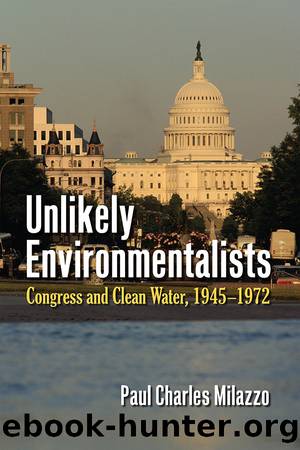
Author:Paul Charles Milazzo [Milazzo, Paul Charles]
Language: eng
Format: epub
Tags: Legislative Branch, Environmental Conservation & Protection, Political Science, American Government, Nature
ISBN: 9780700614752
Google: Akh-AAAAMAAJ
Goodreads: 1133874
Publisher: University Press of Kansas
Published: 2006-10-26T00:00:00+00:00
The GAO and the Promise of Planning
Before the Corps of Engineers could act to fill a bureaucratic vacuum, someone had to point out that one existed and needed to be filled. The General Accounting Office (GAO) obliged in 1969, when it released its influential and widely cited study of the FWPCAâs construction grant program. Corps officials took notice and interpreted the GAOâs critique as an invitation to broaden their mission.
The report told a story of misallocated resources and lost opportunities. Between 1957 and 1969, FWPCA awarded $1.2 billion to states, municipalities, and intergovernmental agencies to assist in the construction of over 9,400 treatment works, estimated at a total cost of $5.4 billion. Although these projects helped stem the tide of water pollution, the GAO concluded that the program had not derived optimal benefits from its considerable investment. Many of the sewage plants financed with federal funds operated along waterways where nearby industrial and municipal sources persisted in discharging raw or inadequately treated waste. These effluent loads curtailed the impact of capital-intensive treatment. Such results were inevitable, the GAO concluded, when the agency administering the grant program prioritized treatment projects purely as a function of local financial capacity or pollution abatement needs. Ideally, administrators needed to judge an individual projectâs contribution to water quality relative to the aggregate activity along a particular stream. Such planning would prove even more essential in the future, given shrinking domestic budgets.34
To account for these variables, the GAO called for a now-familiar solutionâthe âapplication of systems analysis techniques to water pollution problems.â A more thorough systems approach would allow planners to coordinate individual treatment plants within a framework designed to achieve a particular standard of ambient quality in the most cost-efficient manner. The auditors based their conclusions on an external study of the Merrimack, the river that had helped inspire the Corps of Engineersâ own reassessment of water quality planning.35
Environmental policymakers concurred with the GAOâs assertion that ineffective planning had hampered the federal water pollution control effort. In its 1970 report to Congress, The Economics of Clean Water, the FWPCA admitted that the allocation of funds for treatment plant construction had been âunguided by effective priority considerations.â It encouraged the formation of river basin organizations to manage waste despite the practical political resistance from industry and local officials who resented âsuch special purpose governmental units.â The Council of Environmental Qualityâs first annual report in 1970 touted a similar system. When the EPA took over from the FWPCA in 1971, it, too, hoped to base future construction grants on river basin or metropolitan regional plans for water pollution abatement, drawn up by state and local agencies.36
Download
This site does not store any files on its server. We only index and link to content provided by other sites. Please contact the content providers to delete copyright contents if any and email us, we'll remove relevant links or contents immediately.
The Secret History by Donna Tartt(19088)
The Social Justice Warrior Handbook by Lisa De Pasquale(12190)
Thirteen Reasons Why by Jay Asher(8910)
This Is How You Lose Her by Junot Diaz(6887)
Weapons of Math Destruction by Cathy O'Neil(6280)
Zero to One by Peter Thiel(5802)
Beartown by Fredrik Backman(5754)
The Myth of the Strong Leader by Archie Brown(5507)
The Fire Next Time by James Baldwin(5446)
How Democracies Die by Steven Levitsky & Daniel Ziblatt(5219)
Promise Me, Dad by Joe Biden(5153)
Stone's Rules by Roger Stone(5088)
A Higher Loyalty: Truth, Lies, and Leadership by James Comey(4964)
100 Deadly Skills by Clint Emerson(4925)
Rise and Kill First by Ronen Bergman(4789)
Secrecy World by Jake Bernstein(4753)
The David Icke Guide to the Global Conspiracy (and how to end it) by David Icke(4720)
The Farm by Tom Rob Smith(4512)
The Doomsday Machine by Daniel Ellsberg(4490)
